Evaluating Saint Patricks Day Seamless Patterns for Holiday Design Projects
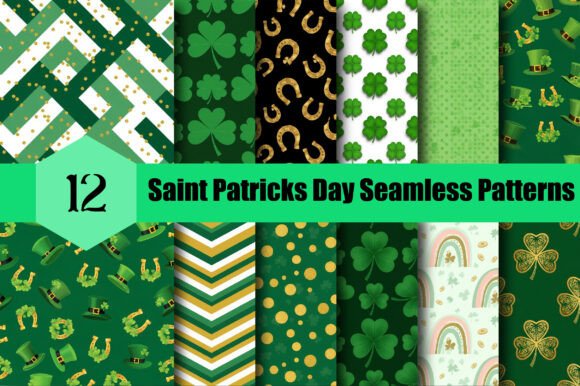
The approach of March 17th signals a surge in demand for thematic design assets, particularly those centered around Irish heritage and folklore. For designers, crafters, and small business owners, selecting the right visual elements is crucial for creating cohesive and professional-looking materials. Saint Patricks Day Seamless Patterns represent a specific category of digital resources designed to meet this seasonal need. These assets typically feature high-resolution, repeating backgrounds incorporating iconic symbols such as shamrocks, clovers, leprechaun hats, rainbows, and gold coins. Understanding the utility, limitations, and ideal applications of these patterns is essential for anyone looking to integrate them into print or digital workflows effectively.
Defining the Asset Category
At their core, Saint Patricks Day Seamless Patterns are digital image files engineered to tile infinitely without visible seams or breaks. When placed side-by-side or stacked, the edges align perfectly to create a continuous background. This technical characteristic distinguishes them from standard illustrations or single-page graphics. The collection described in this evaluation focuses on vibrant green tones and classic Irish motifs, delivered as high-quality JPG files at 300 DPI (dots per inch). This resolution standard is significant because it ensures clarity in both screen-based displays and physical printing, bridging the gap between digital marketing materials and tangible products like wrapping paper or invitations.
Strategic Benefits for Creators
The primary advantage of utilizing seamless patterns lies in their versatility and scalability. For a graphic designer working on a large-format project, such as a trade show banner or a roll of wrapping paper, a seamless pattern allows for expansion to any size without pixelation or loss of detail, provided the source file resolution is sufficient. The 300 DPI specification mentioned in many premium collections supports this, offering enough data density for professional offset printing and high-quality home inkjet outputs.
Furthermore, these patterns streamline the production process. Instead of manually arranging individual clip art elements to fill a space—a task that can be time-consuming and often results in uneven spacing—users can apply a seamless pattern as a background layer. This efficiency is particularly valuable for small business owners who may be producing hundreds of party invitations, greeting cards, or planner stickers in a short timeframe. The consistency offered by a repeating pattern ensures a uniform aesthetic across all produced items, reinforcing brand identity or event themes.
Ideal Use Cases and Applications
Determining whether Saint Patricks Day Seamless Patterns are the right fit depends largely on the intended medium. These assets excel in scenarios requiring extensive surface coverage. For instance, in the realm of scrapbooking and DIY crafts, they serve as excellent backing papers for photo layouts or handmade cards. In the commercial sector, they are highly effective for sublimation designs, where the pattern is transferred onto textiles, mugs, or tumblers. The repeating nature of the design ensures that the imagery looks intentional and complete regardless of how the physical object is cut or shaped.
Digital applications also benefit significantly from these resources. Social media graphics, website headers, and email newsletters often require engaging backgrounds that do not distract from foreground text. A subtle, seamless pattern of clovers or rainbows can add festive context without overwhelming the message. Additionally, for those creating digital planners or sticker sheets, these patterns provide a ready-made texture that adds depth and visual interest to otherwise flat vector icons.
Considerations and Tradeoffs
While the benefits are substantial, there are tradeoffs to consider when selecting seamless patterns over other design elements. The most notable limitation is the potential for repetitiveness. If a pattern has a small repeat unit or a very distinct motif, it can become visually monotonous when tiled over a large area. Users must evaluate the scale of the pattern relative to their project size; a pattern that looks balanced on a business card might appear too busy or chaotic on a poster.
Another consideration is the file format. While JPG is widely compatible and suitable for photographic-style patterns with complex color gradients, it is a lossy format. For projects requiring transparency, such as overlaying a pattern on top of another colored background without a white box around it, JPGs are insufficient. In such cases, users might need to seek alternatives in PNG or vector formats (SVG/EPS), which support alpha channels and infinite scalability without quality degradation. However, for full-background coverage where opacity is not an issue, the high-resolution JPGs found in these collections are generally adequate.
Comparing Alternatives
When evaluating Saint Patricks Day Seamless Patterns, it is helpful to compare them against alternative approaches. One alternative is using isolated clip art elements. This method offers greater creative control, allowing the designer to place specific symbols exactly where desired. However, it requires more skill and time to arrange compositionally. Another alternative is custom illustration, which guarantees uniqueness but comes with higher costs and longer lead times.
Seamless patterns occupy a middle ground: they offer more structure than loose clip art but are more cost-effective and immediate than custom work. They are the optimal choice when speed, consistency, and full-coverage texture are prioritized over unique, one-off compositions. If a project demands a highly specific narrative scene rather than a decorative background, isolated elements or custom art would be superior choices.
Making the Selection Decision
To determine if this specific set of Saint Patricks Day Seamless Patterns aligns with your goals, assess your technical requirements first. If your workflow involves standard printing processes or digital display where 300 DPI JPGs are acceptable, these files provide a robust foundation. Evaluate the color palette; while green is traditional, ensure the specific shades in the collection match your existing brand guidelines or event color scheme.
Ultimately, the decision rests on the balance between convenience and customization. For those needing to produce high volumes of festive material quickly—such as party favors, bulk invitations, or seasonal social media campaigns—these seamless patterns offer a practical, high-quality solution. They remove the technical barrier of creating repeating backgrounds from scratch, allowing creators to focus on layout, typography, and messaging. By understanding the strengths of seamless tiling and the specific attributes of high-resolution holiday assets, users can make informed choices that enhance the professional quality of their St. Patrick's Day projects.